As Fox 35 Orlando reported, "This will help make sure our facility is secure."
That was Edgewater Mayor Diezel Depew, talking about a wastewater treatment plant most residents never think about, after Hurricane Ian filled it with nearly five feet of water and forced a shutdown that sent sewage backing up into homes and streets. The Volusia County Council has since approved a project to replace the plant's pumps, filters, and electrical systems, backed by a roughly $200,000 federal grant, so the facility can keep running through the next storm instead of failing again.
That flood was not the only warning sign. A separate stretch of heavy rain dropped up to six inches on Florida Shores in a matter of days and flooded around 50 homes. Depew has said the city's stormwater master plan has not been updated since 2014.
Those stories put local infrastructure on a buyer's radar. Separately, buyers may want to check whether a specific Edgewater street is included in the county's plan, which prioritizes potential central-sewer projects. A separate city rule may require connection when a septic system fails or a repair permit is requested, if a gravity sewer line is available.
The list Volusia County already published
Volusia County's Septic System Reduction Plan does not describe Edgewater in the abstract. It names blocks.
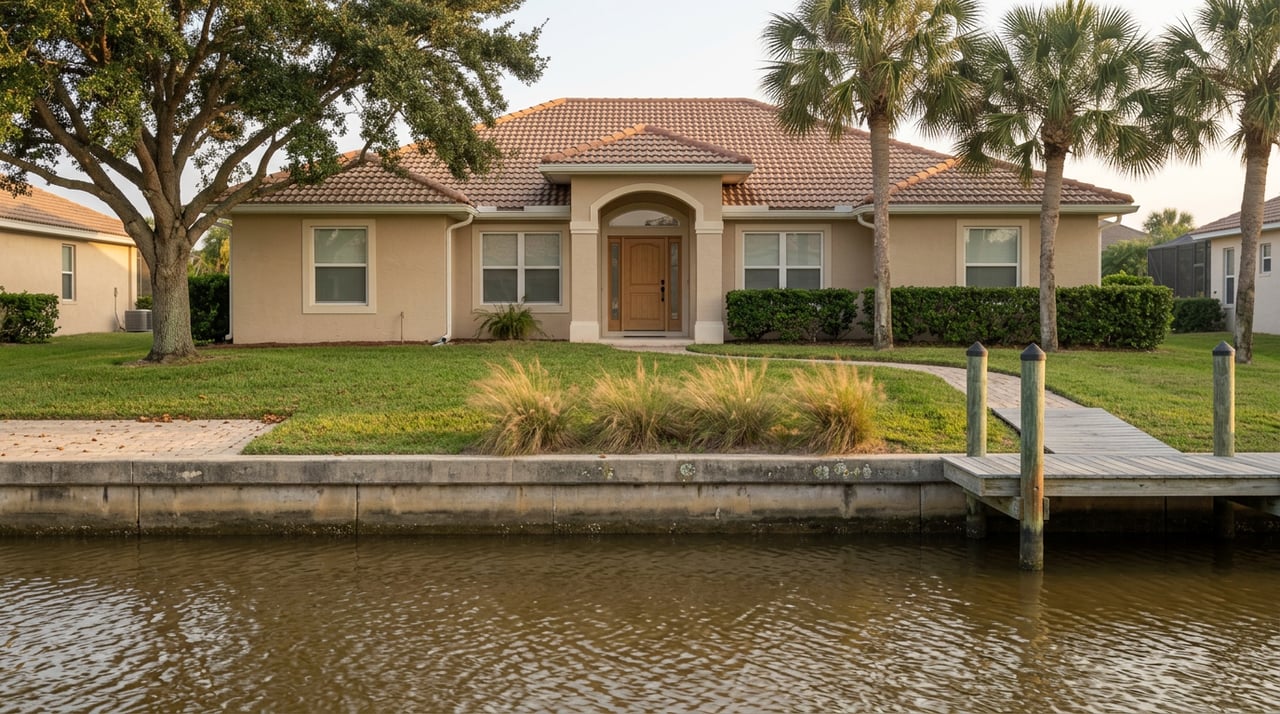
The largest one sits between Poinciana Road, Godfrey Road, US Highway 1, and the Mosquito Lagoon, roughly 240 lots, most of them backing onto canals that feed straight into the lagoon. The county classifies this area as medium density and ranks it high priority for a central sewer retrofit.
A second block runs along Barberry Drive, Eaglewatch Road, and HH Birch Road, also between US Highway 1 and the lagoon. About 47 lots, with roughly 25 of them still running active septic systems, also ranked high priority.
A third, smaller pocket sits along William Street and Myrtle Street, about 40 lots, with roughly a quarter of them adjacent to the lagoon itself. This one is ranked medium priority, lower density and less urgency, but still on the list.
| Area | Approx. lots | Priority |
|---|---|---|
| Poinciana Rd / Godfrey Rd, between US-1 and Mosquito Lagoon | ~240 | High |
| Barberry Dr, Eaglewatch Rd, HH Birch Rd | ~47, about 25 on active septic | High |
| William St / Myrtle St corridor | ~40 | Medium |
None of this is secret. It sits in a public planning document. Almost none of it shows up during a showing.
What actually flips the switch
Here is the part that matters at closing, not at some theoretical future date. Edgewater's own annexation guidance spells out the trigger: if a gravity sewer line is already adjacent to or available for a property, that property can be required to connect to the city system the moment its septic tank fails, or the moment a permit is requested from the county health department to repair or replace a drain field. That rule applies whether the parcel sits inside city limits or in an unincorporated pocket next door. Annexation status does not change it.
In practice, the trigger is not a countywide deadline circled on a calendar. It is a plumbing event. A local septic contractor who works Edgewater every week points out that the soil here is sandy and the water table sits high, which makes an overdue tank riskier than in most inland Florida markets, and that a lot of the tanks in Florida Shores are decades old. A buyer who inherits one of those tanks is not just inheriting a maintenance item. They are inheriting the possibility that a septic failure or a repair-permit request could trigger a required sewer connection if a gravity line is available.
That is worth a specific question during due diligence, not a general one. Ask how old the septic system is, when it was last pumped, and whether the parcel sits inside one of the priority zones the county has already mapped. A standard four-point inspection will not always surface that last piece. The county's plan is public record and worth checking against the actual property address before an offer goes in, not after.
Annexation status carries its own ripple effects beyond the sewer trigger, too. City documentation notes that properties brought into Edgewater typically gain access to city water and sewer where available, along with a likely reduction in fire insurance and, in some cases, property insurance. None of that changes whether a parcel sits in a priority sewer zone, but it does mean two otherwise similar homes, one inside city limits and one just outside it, can carry different costs that are easy to miss from a listing sheet alone.
The bill that looks like a water bill and is not
There is a second wrinkle that has nothing to do with which zone a property lands in and everything to do with how Edgewater bills for utilities at all.
The city rolls water, sewer, stormwater, and garbage and recycling into one monthly utility bill. Edgewater's own billing page notes that this gets confused for a plain water bill when compared against nearby communities, because several of those cities handle stormwater and some solid waste charges through an annual tax assessment instead of a monthly line item. Two homes with identical square footage and identical list price can carry meaningfully different real monthly costs depending on which side of a city line they sit on and how each city chooses to bill for the same services. That is not a septic-versus-sewer question. It is a reason to pull the actual utility bill on any specific address under serious consideration, rather than assume the number on one listing translates cleanly to the next.
What this looks like at today's numbers
Edgewater is not a fast market right now, and that changes how much room a buyer actually has to ask these questions before signing anything. The typical home value in the Edgewater 32141 zip code sat at roughly $302,600 as of early July 2026, up about 4.7 percent annually over the past five years. Sold prices tracked through July 2026 showed a median closer to $349,900, and homes were sitting for a median of 156 days before selling, compared with 115 days the year before.
That slowdown is not unique to septic zones. It reflects a broader cooling across Volusia County, where list-to-sale price ratios in 2026 have settled between 97 and 99 percent, down from the 103 to 106 percent ratios typical during 2021 and 2022's bidding wars. But it does mean a buyer today has more room to ask for a septic inspection, more room to request documentation on where a property sits relative to the county's priority list, and more room to negotiate around what they find, without losing the house to a backup offer that skipped the question entirely.
A few questions worth asking before you write an offer
- Is this address inside one of the three priority zones the county has already identified, or somewhere else on septic that has not made the list yet?
- When was the septic tank last pumped, and does the seller have that receipt?
- Is a gravity sewer main already adjacent to the lot, which is the specific trigger for mandatory connection under city rules?
- What does the actual monthly utility bill look like for this address, not the average for the city?
None of these questions require a specialist. They require asking before you are three weeks into a contract.
Frequently asked questions
Does living in one of the priority zones mean I have to pay for a sewer hookup right away? Not automatically. The county's plan sets priority for future central sewer projects and funding requests. The city's connection requirement is triggered by septic failure or a repair permit request, not by the plan's existence on its own.
Is Florida Shores entirely on septic? No. The neighborhood has a mix of ages and systems, but a local septic contractor working the area regularly describes many of its tanks as decades old, which raises the odds of needing service or replacement sooner than in newer construction.
Does buying with cash avoid any of this? No. The connection trigger is tied to the condition of the septic system and the permit process, not to how the purchase is financed.
Where can I check whether a specific address is in a mapped priority area? Volusia County's Septic System Reduction Plan is public and describes each area by its bounding streets. An agent who works Edgewater regularly can help match a specific address against that description before an offer goes in.
Ready to check a specific Edgewater address against this list before you fall for a listing photo? Megan Guerrero works this market street by street and can pull the utility history and septic status on any property you're considering. Schedule a free consultation or get your free home valuation today.
This article is general information, not legal, tax or financial advice. Consult a qualified professional about your situation.