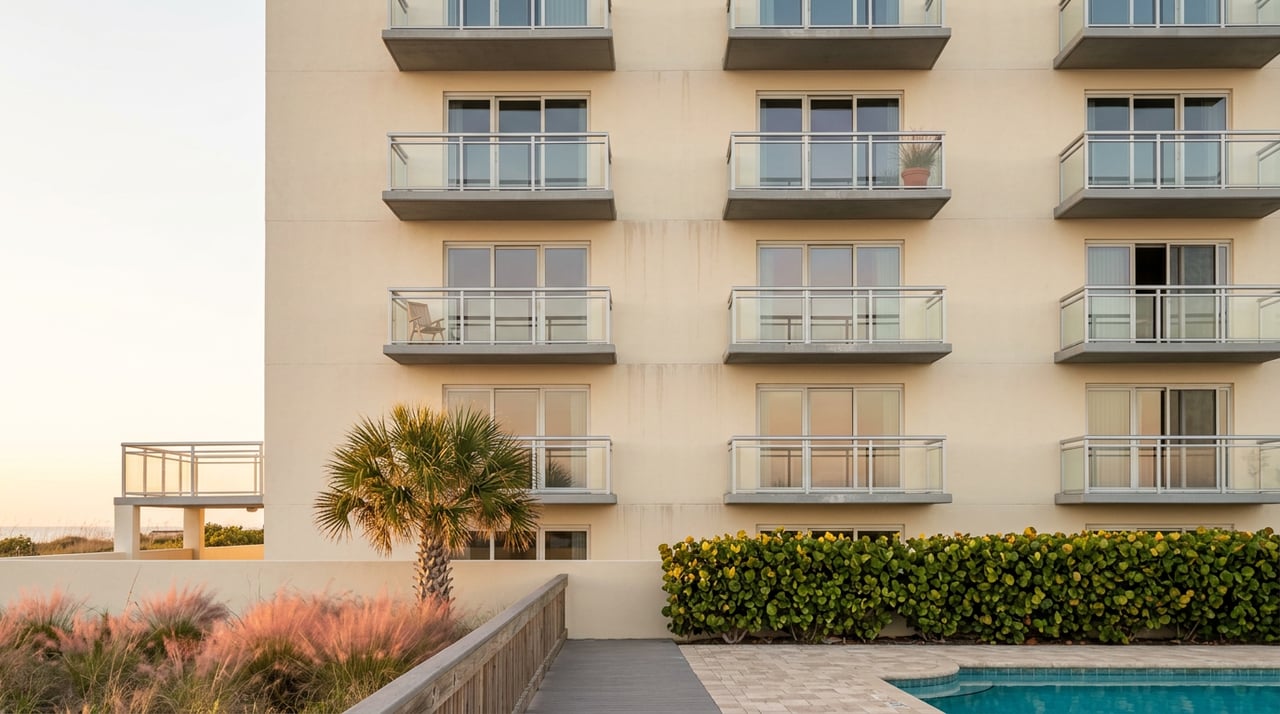
Most people searching "Daytona Beach short-term rental" are really asking two different questions without knowing it. The city of Daytona Beach and the separate city of Daytona Beach Shores sit on the same barrier island, share the same three-digit area code, and get lumped together in casual conversation as one beach town. They are not one beach town. They are two municipal governments with two different rulebooks for whether a condo can legally host a guest for a weekend, and the line between them runs through the middle of what most buyers assume is a single market.
If you're shopping for a rental property here, that line matters more than square footage or view.
The core tourism area has a name, and it has boundaries
Daytona Beach's zoning code does not treat overnight rentals as a citywide right. It confines them to a small footprint: four Tourist zoning districts and thirteen Redevelopment zoning districts, mapped out on the city's own zoning GIS portal. Everywhere else in Daytona Beach, a rental under 30 days is classified as a hotel or motel use, and that use is not permitted in residential zoning. A house two blocks outside the tourist corridor can look identical to one inside it and still be entirely off-limits for nightly guests.
Hometown News reported that the boundary itself has a shape city planners have described as the beachside area bordered roughly by International Speedway Boulevard, Oakridge Boulevard, Halifax Avenue and Atlantic Avenue, an area the city has called its core tourism zone. That's the footprint where "other accommodations" use is currently allowed. Step outside it and the calculus changes completely, no matter how close you still are to the sand.
This isn't a theoretical distinction. In March 2022, the Daytona Beach City Commission voted unanimously to ask the Florida Attorney General for an opinion on whether it could create a new overlay district to allow more vacation rentals near that tourist corridor without technically expanding the citywide rule. The city's own filing, prepared through City Attorney Robert Jagger, argued the change was needed because "residential neighborhoods. .. have suffered from economic stagnation" in that stretch compared to other parts of town. The Attorney General's office ultimately concluded in a November 2022 opinion that the proposed overlay would have regulated the frequency of vacation rentals in a way state law doesn't allow local governments to do, since Florida's 2011 preemption law bars cities from banning or limiting vacation rental duration or frequency, except for rules already on the books before June 2011. Daytona Beach's current restrictions survive because they predate that law. New carve-outs do not get the same protection.
The upshot for a buyer: the zoning map you're looking at today reflects a boundary the city itself has already tried, and failed, to expand. That's worth knowing before you fall in love with a property just outside the line, hoping the rules will eventually catch up to it.
Three miles south, a different government altogether
Daytona Beach Shores is its own incorporated city, established in 1960, running along a roughly three-mile stretch of A1A between Daytona Beach to the north and Ponce Inlet to the south. Most of its housing stock is condominiums, and it has historically taken a more permissive stance at the ordinance level toward nightly and weekly rentals than its neighbor to the north.
That permissiveness has real consequences in the sales data. Over the three months ending June 2026, homes in Daytona Beach Shores, the overwhelming majority of them condos, sold for a median of $410,000, up 12.3% from the same period a year earlier. In a separate three-month period ending April 2026, Daytona Beach's own single-family median sat closer to $320,000, up a modest 1.5% year over year. The figures offer separate snapshots of two cities on the same island, with different price points and rental rules: one offers a broader legal path to rental income, while the other keeps that path narrow.
But permissive at the city level doesn't mean unrestricted at the building level. Individual condo associations in Daytona Beach Shores set their own minimum-stay rules, and those rules can be far stricter than what the city allows. Some oceanfront buildings, including well-known names like the Sunglow Resort and Hawaiian Inn, permit rentals. Others in the same zip code have stricter minimum-stay rules, regardless of what city ordinance says is technically legal. Buyers who assume "the city allows it" settles the question have been surprised to learn their specific building's HOA docs say otherwise. The city sets the ceiling. The HOA can lower it.
What the line costs you every year, not just at closing
The zoning difference gets the attention, but there's a second gap between these two cities that shows up on every tax bill: millage rates. Daytona Beach's total millage runs meaningfully higher than Daytona Beach Shores', and Volusia County's Property Appraiser is the place to confirm the exact current rate for any specific parcel before you make assumptions. The gap is large enough that on a comparably priced home, the difference in annual property tax between the two cities can run into the thousands of dollars.
Add that to the rental-eligibility question and you get a fuller picture of what "the same beach, different city" actually means for an investor's return: one line on the map affects both what you're allowed to do with the property and what it costs you to hold it every year you own it.
| Daytona Beach (city proper) | Daytona Beach Shores | |
|---|---|---|
| Housing mix | Mainland and beachside, mostly single-family | Roughly 80% condominium, beachside only |
| Where nightly rentals are legal | Four Tourist districts plus thirteen Redevelopment districts only | Broader city-level allowance, subject to each building's HOA |
| Recent median sale price | About $320K, single-family, three months ending April 2026 | About $410K, three months ending June 2026, up 12.3% year over year |
| General millage comparison | Higher | Lower, verify current rate with the county before relying on it |
What this means if you're comparing the two
Before you write an offer with rental income built into your numbers, a few things are worth confirming in writing rather than assuming:
- Pull the property's actual zoning classification from the city's zoning GIS portal rather than relying on a listing description. "Near the beach" is not the same as "inside a Tourist or Redevelopment district."
- If you're looking at a condo in Daytona Beach Shores, request the association's governing documents and ask directly about minimum stay length. City permission and building permission are two separate approvals.
- Confirm the current millage rate for the specific parcel with the Volusia County Property Appraiser rather than using a citywide average, since special taxing districts can shift the number.
- If a property sits just outside the current tourist corridor in Daytona Beach and you're hoping zoning will loosen, know that the city's own 2022 attempt to expand that boundary was turned back by the state, so treat that hope as speculative, not a plan.
None of this makes either city a wrong choice. It makes them different products with different rules, and the buyers who do best here are the ones who price that difference in up front instead of discovering it after closing.
Frequently Asked Questions
Does Daytona Beach ban short-term rentals entirely? No. They're permitted within four designated Tourist zoning districts and thirteen Redevelopment zoning districts. Outside those areas, rentals under 30 days are treated as a hotel or motel use and aren't allowed in residential zoning.
If a condo in Daytona Beach Shores is in a city that allows nightly rentals, can I always list it short-term? Not automatically. The city's ordinance sets what's legally possible, but the condo association's own rules can require longer minimum stays regardless of what the city permits. Always check the building's governing documents directly.
Is Daytona Beach Shores' price growth guaranteed to continue? No one can promise future appreciation. What the recent data shows is that Daytona Beach Shores posted a year-over-year gain in its most recent three-month window while some neighboring markets cooled, which is useful context for understanding current demand but not a forecast.
Whether you're weighing a rental-ready condo on the Shores side or a single-family home inside Daytona Beach's own tourist corridor, the zoning line and the tax line both deserve a real conversation before you write an offer. Megan Guerrero works these coastal Volusia markets every week and can walk you through what a specific address is actually zoned for, what a specific building's rental rules allow, and what your real annual carrying cost looks like once the county's current millage is factored in. Reach out for a free consultation before you assume the beach house on one side of the line behaves like the one on the other.
This article is general information, not legal, tax or financial advice. Consult a qualified professional about your situation.